
Breast Imaging: Types, What They Do, and How They Detect Breast Cancer
Breast imaging allows doctors to visualize breast tissue to identify both benign and malignant abnormalities – sometimes years before they can be felt during a physical exam. They are a powerful tool in breast cancer detection and can detect abnormalities earlier.
For women wondering which test to choose, how accurate it is, and what to expect, this guide walks you through the main types of breast imaging, how they differ, and when each is used.
What Is Breast Imaging?
In the simplest terms, breast imaging means using medical devices (X-rays, sound, magnets, etc.) to create pictures of breast tissue. The goal is to detect changes (like lumps or microcalcifications) as early as possible. Some imaging is done routinely (screening), while other imaging is diagnostic and only done when your provider finds something suspicious.
Types of Breast Imaging (and What Each Does)
Mammogram
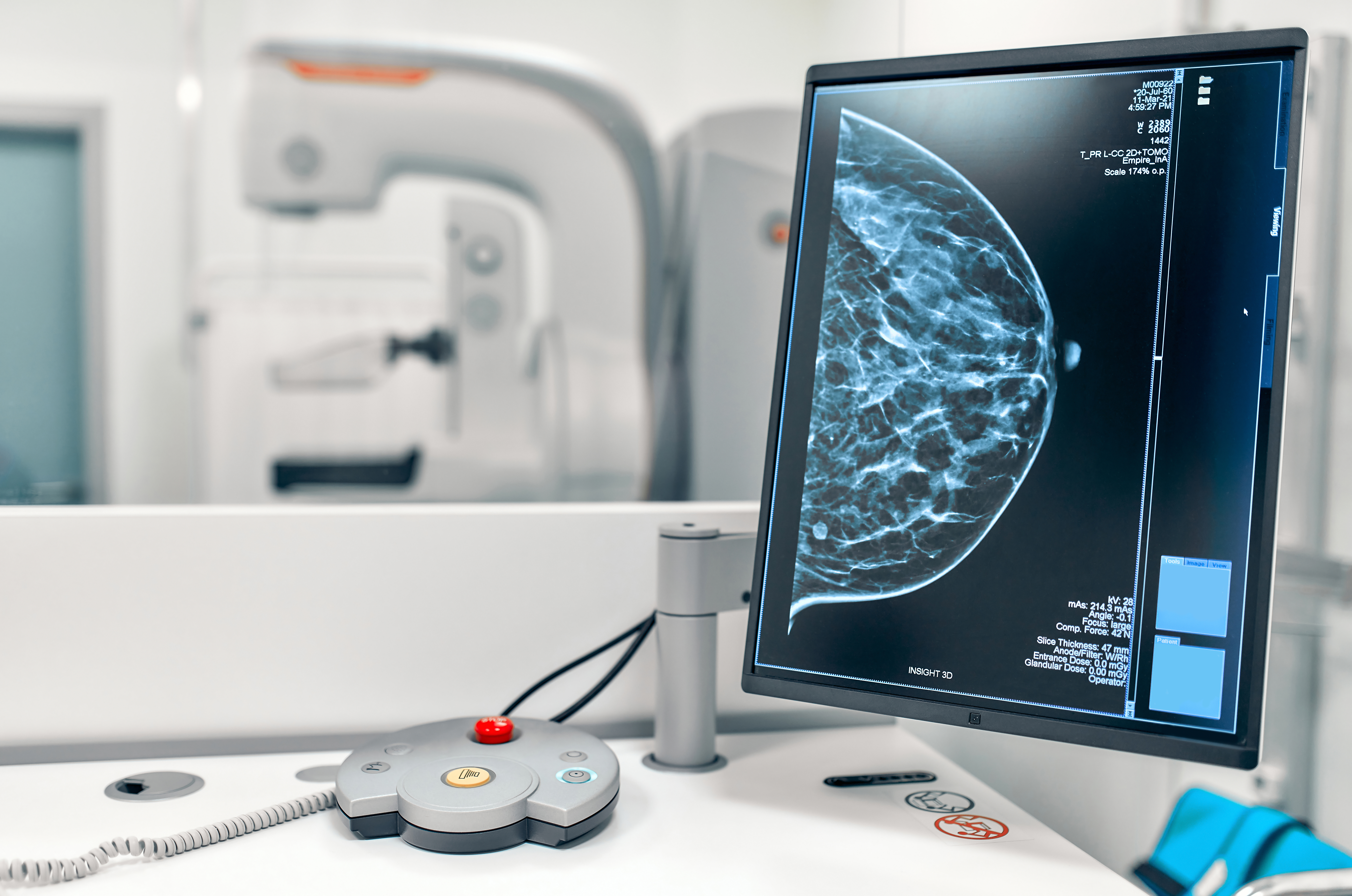
A mammogram is the backbone of breast cancer screening. It’s a breast imaging technique that uses low-dose X-rays to detect changes in breast tissue even before you or your doctor feel anything. They are typically performed every 1 – 2 years starting at age 40 (depending on guidelines and risk).
They can detect small masses, clusters of microcalcifications, architectural distortion, and asymmetries. Mammograms can show changes up to two years before they can be felt.
3D Mammography or Tomosynthesis
3D mammography (also called digital breast tomosynthesis) is an advanced form of digital mammography that captures images from multiple angles, reducing tissue overlap and improving cancer detection, especially in dense breasts. If you have dense breasts, where dense tissue and tumors both appear white on X-ray, a 3D mammogram may be the best option.
Ultrasound
A breast ultrasound uses sound waves (no radiation) to visualize breast tissues in real time. It is commonly used in diagnostic breast imaging to follow up on suspicious mammogram findings or when a lump is felt but not clear on a mammogram. The ultrasound is an excellent diagnostic tool to evaluate physical lumps or clarify unknown findings on a mammogram. While not typically used alone for routine screening, it is often added for women with dense breasts.
Breast MRI (Magnetic Resonance Imaging)
Breast MRI uses magnetic fields, radio waves, and often intravenous contrast (gadolinium) to create 3D, high-detail images of the breast.
It is not a first-line screening tool for average-risk women; rather, it serves as a supplemental or diagnostic tool in high-risk settings or when other tests are inconclusive.
Uses of an MRI include:
- Screening in women at high risk (e.g., strong family history, genetic predisposition)
- Evaluating the extent of known breast cancer, how big it is, whether it has spread, and additional lesions in either breast.
- Following up on abnormalities that mammogram + ultrasound couldn’t fully assess
The MRI is more sensitive than mammography or ultrasound and is recommended annually for women at high risk (>20% lifetime risk) or for evaluating the extent of known cancer. However, it is less specific, can produce false positives, and is more expensive.
Emerging Imaging Technologies
Beyond the standard imaging techniques, there are emerging technologies that may help us detect cancer faster, more accurately, or less invasively. These more experimental forms of imaging still need additional testing, but may have a promising future:
- Molecular Breast Imaging (MBI): Uses radiotracers that cancer cells uptake more than normal tissue. It could help detect lesions in dense breasts or when mammograms/ultrasounds are inconclusive.
- Contrast-enhanced Mammography: CEM injects a contrasting dye and takes X-ray images to highlight areas with increased blood flow (potentially cancer).
- QT Imaging (Whole-breast ultrasound): Quantitative Transmission (QT) is a newer 3D ultrasound method. It is sometimes presented as an alternative to mammography, but guideline bodies still maintain mammography as the screening foundation.
- Galactography (Ductography): Radiographic imaging of breast ducts by injecting contrast dye via the nipple; used when nipple discharge is present.
- Diffuse Optical Mammography/Optical Imaging: An experimental method using near-infrared light to assess tissue composition and oxygenation.
These methods are not yet part of standard screening recommendations but may become valuable aides in the future. Always consult a specialist to understand if they’re appropriate.
What to Expect at an Imaging Appointment
Most imaging techniques are relatively quick, in-office procedures. Here’s what you can expect and how you can prepare.
Preparation
Depending on the type of imaging you’re having, you may have to prepare ahead of time, so always check with your provider in advance. For mammograms, avoid deodorants, powders, and lotions on your breasts or underarms (they can interfere with imaging).
Procedure
- Mammogram: Your breast is compressed between two plates for a few seconds – it may cause discomfort, but the pressure helps reduce blurring and improves image quality.
- Ultrasound: A gel is applied, and a handheld probe moves over the surface. Painless and no compression.
- MRI: You’ll lie still in a tunnel-like machine. Contrast dye is injected. The exam takes longer (often 30–60 minutes).
Safety
- Mammographic methods use ionizing radiation, but at low doses considered safe for screening.
- Ultrasound and MRI (without contrast) use non-ionizing energy.
- Contrast agents carry small risks, typically allergic reactions or kidney considerations; MRI is contraindicated in some patients with certain metal implants or pacemakers and in those with severe kidney disease.
If you have any concerns about radiation, allergies or other safety issues, speak with your Square Care Health provider ahead of time. There are different types of breast imaging techniques available; they can help you find a suitable option.
What’s The Difference Between Imaging Technologies?
MRI vs Ultrasound (Breast)
- MRI: higher sensitivity, better for dense tissue, more expensive, needs contrast, and has more false positives.
- Ultrasound: better for characterizing lumps, no radiation or contrast, cheaper and more available.
Often, these modalities complement each other rather than compete.
2D vs 3D Mammogram (tomosynthesis)
- 3D offers better lesion separation, fewer overlapping tissues, fewer false positives/recalls, and improved performance in dense breasts.
- Many clinics now offer digital mammogram + tomosynthesis as the default screening.
- However, the standard 2D mammogram remains widely accepted and effective in average-risk settings.
QT Imaging vs Mammogram
QT (whole-breast ultrasound) is proposed as a non-radiation alternative to mammography in some media reports. However:
- It’s still largely investigational.
- It is not a replacement for mammograms according to current major guidelines — mammography remains standard for screening.
- QT may someday become a supplemental tool in specific contexts, but for now, it’s not standard of care.
When to Start and How Often: Screening Guidelines
Current guidelines from the U.S. Preventive Services Task Force (USPSTF) recommend:
- Women aged 40 to 74 should get a mammogram every 2 years (biennial screening).
- For women 75 and older, evidence is insufficient to weigh the balance of benefits vs harm.
- While supplemental screening (ultrasound or MRI) detects more cancers in women with dense bre USPSTF.
Other organizations (e.g., the American College of Radiology) sometimes recommend annual mammograms starting at age 40, particularly in higher-risk individuals.
These differences highlight that screening is not one-size-fits-all. Risk assessment and personal preference matter.
Breast Cancer Imaging in Long Island, NY
Breast imaging offers powerful tools for early detection of breast cancer. Each modality has its strengths and limitations. Your Square Care provider will know what is best for you and will be happy to answer any questions about risks, results and what to expect. Early detection saves lives. Understanding the types of breast imaging and how they work helps you be an informed partner in your care.
At Square Care, we offer on-site mammography services at three locations across Long Island, NY, making this critical diagnostic tool accessible. Request an appointment today and take control of your health.